Thunder is an excellent sound effect with an even better explanation. A lightning flash dumps heat into a narrow channel of air so quickly that the air expands violently. The resulting pressure disturbance travels outward. By the time it reaches your ears, a very brief heating event has become a sky-filling announcement. [1]
The temperatures are ridiculous by everyday standards. Lightning can heat the surrounding air to roughly 30,000 degrees Celsius, or 54,000 degrees Fahrenheit, in a fraction of a second. Rapid expansion compresses the air ahead of it and creates a shock wave. The comparison with a sonic boom is useful: both involve a sharp pressure change moving through air. [1]
A bolt is also an extended path, rather than one neat dot making one neat bang. Shock waves form along that path. Sound from different sections can reach a listener at different times, and the waves change as they travel. A sharp crack can stretch into the familiar rolling rumble. The atmosphere is part of the sound system, with its own very large and unpredictable acoustics. [1]
Distance changes the experience, too. NOAA's weather education materials describe nearby thunder as a sharp crack or bang, while distant thunder often becomes a more continuous rumble. Sound travels about a mile in five seconds, although temperature affects its speed. That is why the gap between a flash and its sound can reveal distance. It is a rough physical estimate, not a complete description of where a storm is going. [2]
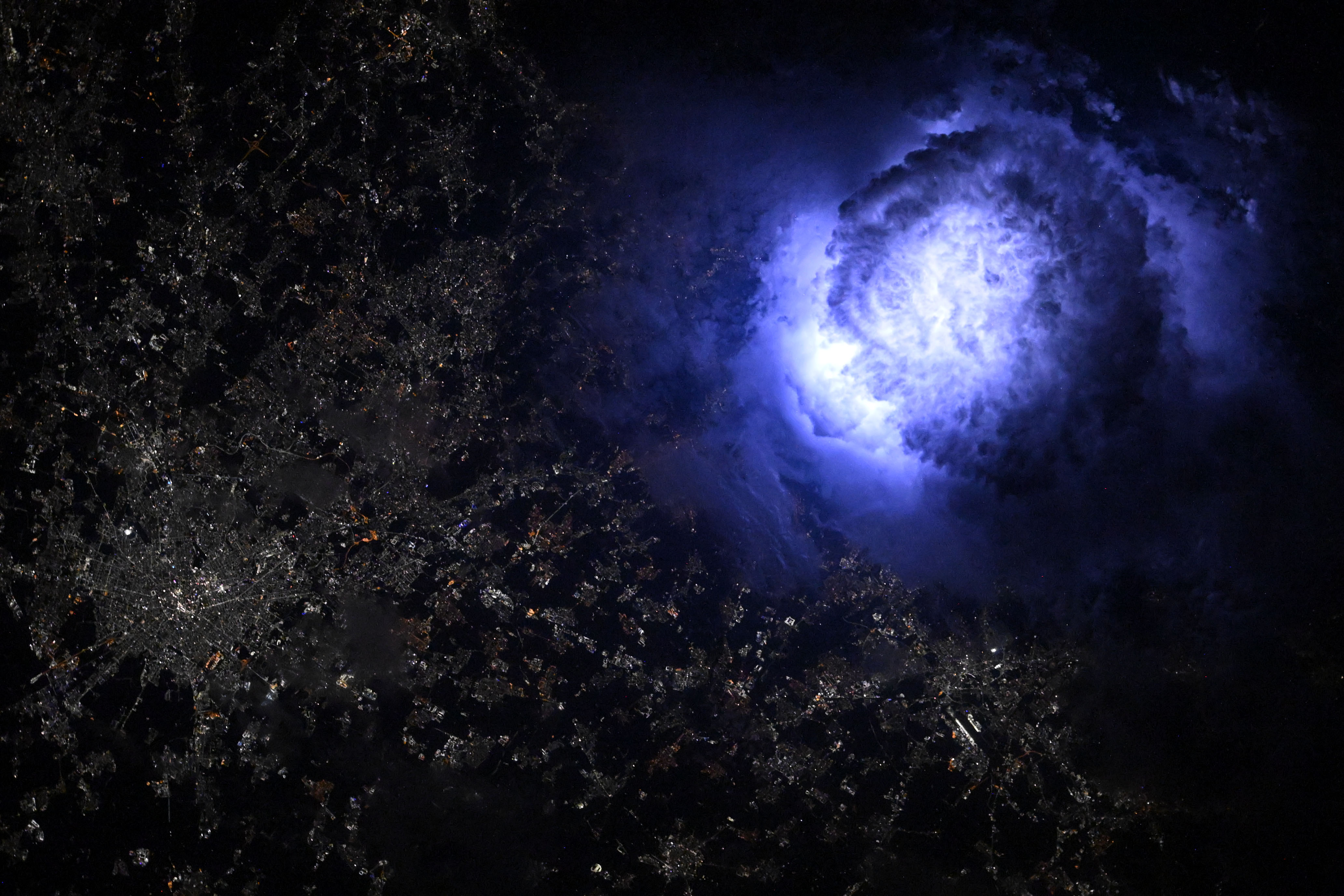
The photograph here provides an unfamiliar seat for the show. Astronaut Nichole Ayers captured lightning above Milan, Italy, from the International Space Station on July 1, 2025. From above, the illuminated cloud becomes an enormous blue-white lamp set among city lights. It is a photograph of the flash, of course; the image cannot carry the pressure wave that makes the noise below. [3]
The most satisfying part of the explanation is the change in scale. Heat acts locally along a lightning channel. The sound then spreads into something that seems to occupy the whole landscape. A moment of electrical activity becomes an experience measured in both space and time. Next time a thunder recording rolls through a film, listen for the journey between the initial crack and the fading tail.