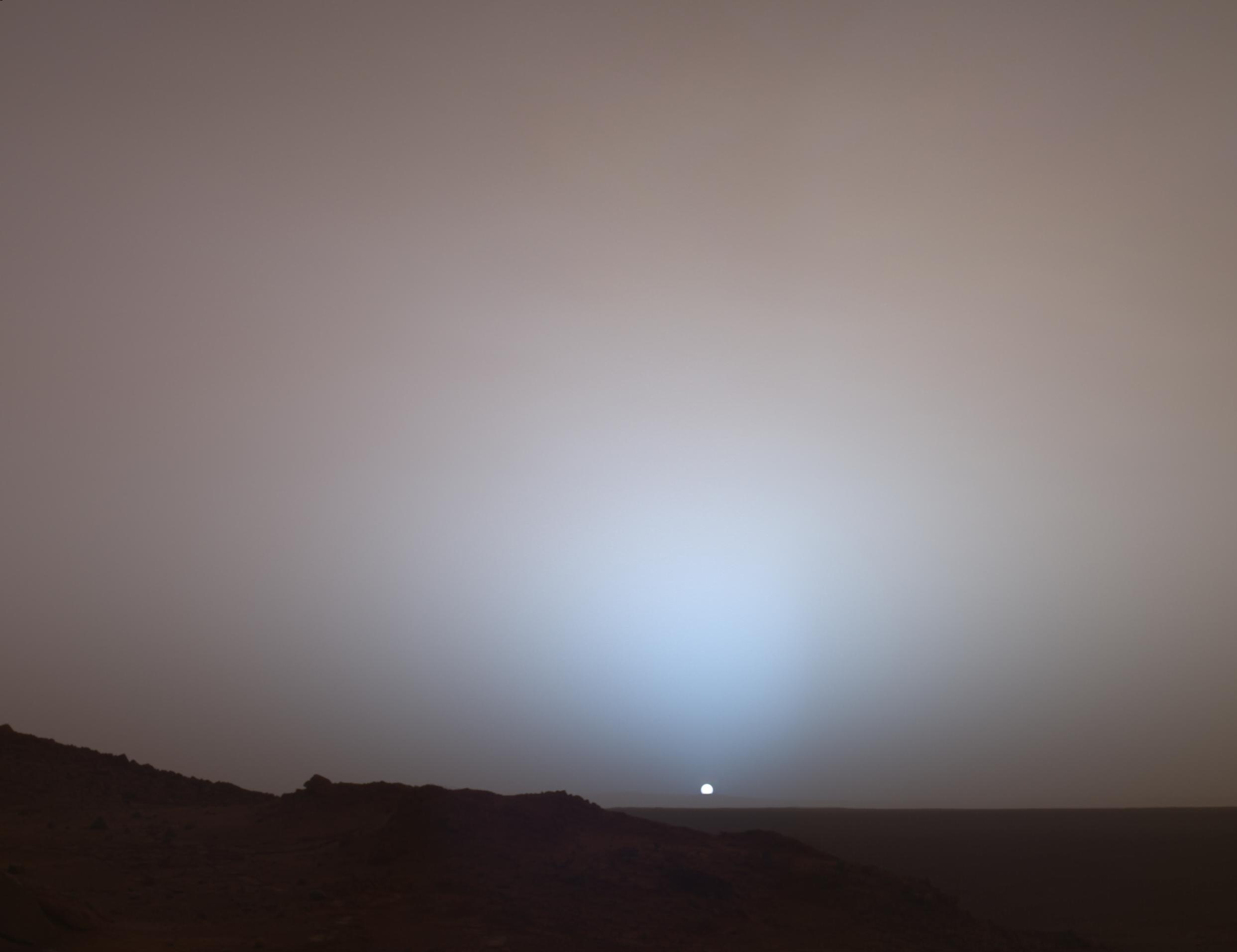
A sunset on Mars comes with a small betrayal of the brand. The planet we associate with rust, red dirt and orange skies can finish the day with a cool blue glow around the Sun. Imagine traveling all that way for golden hour and discovering that the local atmosphere has changed the color palette. [2]
The trick is dust. Fine particles suspended in the Martian atmosphere scatter sunlight in a way that keeps more blue light close to the Sun's direction, while red and yellow light spread more widely. The effect becomes easier to see around sunset, because sunlight takes a longer route through the atmosphere. That extra journey through dusty air makes the blue region more pronounced. [1]
Earth offers a useful comparison. Here, molecules in the atmosphere scatter short blue wavelengths across the daytime sky. Near sunset, sunlight passes through more air, and much of that blue has been scattered away from the direct path. Reds and yellows become prominent. Mars has different atmospheric ingredients and different scattering behavior, so the familiar scene gets a different finish. [2]
The photograph shown here was captured by the Spirit rover at Gusev crater on May 19, 2005. There is a detail worth keeping with the image: it is a panorama assembled using three camera filters, and its colors are somewhat exaggerated. The blue glow is a real feature a visitor could see; the wider sky's redness is enhanced by the way those filters were combined. [3]
These pictures are useful for more than making Earth sunsets feel predictable. Scientists use Martian sunset and twilight observations to investigate how high dust extends and to look for dust or ice clouds. The scene doubles as a measurement of the atmosphere. A postcard can also be an instrument reading, which is a pleasingly efficient use of a very distant camera. [3]
What makes the view stick is how ordinary its arrangement feels: a horizon, a foreground, a small setting Sun. Then the color gently breaks the expectation. That is an excellent kind of alien. No imaginary skyline is required. The strange part is already present in the behavior of light, and a little airborne dust is doing all the production design.