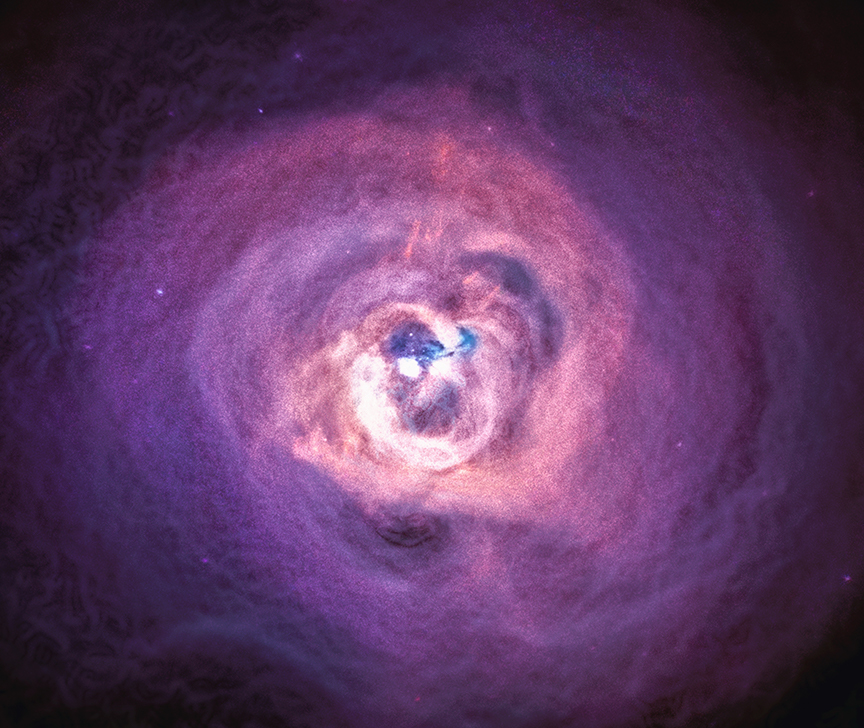
The sound associated with the black hole in the Perseus galaxy cluster has the atmosphere of a haunted ventilation system. That reaction is part of the fun. Understanding how the audio was made adds something better: an appreciation for the extraordinary distance between a physical phenomenon and a sound a human being can actually hear.
The starting point is real pressure waves moving through the cluster's hot gas. Most of space is close enough to a vacuum that ordinary sound has no suitable medium to cross it. A galaxy cluster, however, contains gas through which pressure waves can travel. Observations from the Chandra X-ray Observatory revealed ripples associated with activity around the central black hole. [1]
Those waves are far below the range of human hearing. For the sonification released in 2022, signals extracted outward from the center were reconstructed at pitches 57 and 58 octaves higher. Each octave represents another doubling of frequency. That is an enormous translation, designed to bring otherwise inaudible information into the range our ears can handle. The rotating scan also lets listeners encounter different directions around the image. [1]
Sonification is a broader practice than this particular example. In a NASA interview, visualization scientist Kimberly Arcand describes choosing features in a data set and mapping them into sound. A project's rules might connect energy with pitch, intensity with volume, or a type of light with an instrument. The choices need to communicate the science while remaining clear enough to follow as audio. [2]
Accessibility helps shape that work. Arcand describes collaborating with people who are blind or have low vision, alongside scientists, musicians and sound designers. The task is bigger than giving a space picture a spooky soundtrack. It is another way into information that is often presented visually, with timing, pitch and texture helping carry distinctions a listener can explore. [2]
A useful habit for any cosmic audio clip is to read its production notes. Find out what was measured, which properties were mapped, and whether the pitch or timing changed. Those details do not spoil the experience. They are the liner notes that make it richer. You can enjoy the eerie result and still know exactly where the instrument ends and the interpretation begins.